
Power plant operations involved multiple standalone applications, paper-based workflows, manual archives, and disconnected sources of operational data.
We built a centralized, fully on-premise operations platform to bring those processes together — including an offline Android solution that completely replaced dedicated data-logging devices.
The platform was deployed at two power plants:
Shahid Kaveh Qaen Combined Cycle Power Plant
Qaen Gas Power Plant
2 Power Plants
Production Deployment
~150
Platform Users
~1,000
Equipment & Measurement Points
100% On-Premise
No Internet Dependency
Discuss a Similar Project
Start With a Small Scope
Project at a Glance
Deployments
Shahid Kaveh Qaen Combined Cycle Power Plant
Qaen Gas Power Plant
Industry
Energy & Power Generation
Project Type
Custom Industrial Operations Platform
Engagement
Multi-year Development & Support
Development
2017–2019
Deployment Model
Fully On-Premise
Users
~150
Core Stack
Node.js, Actionhero.js, Ext JS, PostgreSQL, Native Android (Java)
Key Capabilities
Workflow Automation, Operational Reporting, Document Management, System Integration, Offline Field Data Collection
The Challenge
Too Many Disconnected Systems for One Operation
Power plant operations depended on multiple standalone software systems, shared files, manual archives, and paper-based workflows.
Different tools were being used for areas such as shift reporting, administrative correspondence, document and library management, maintenance-related processes, and field data collection.
But the problem wasn’t simply the number of applications.
Information and workflows were fragmented.
Employees had to move between different systems and processes. Documents were not managed through a single environment, and many internal requests still depended on paper or manual coordination.
Management reporting also required information to be collected from separate sources.
There was another major constraint:
Public Internet access was not permitted inside the operational environment for security reasons.
Any new solution therefore had to work entirely within the power plants’ internal infrastructure while still supporting field personnel who needed to collect equipment readings away from network connectivity.
One important field process also depended on dedicated data-logging devices. Operators collected readings using specialized hardware and later had to physically connect those devices to a computer to transfer the data.
So the challenge wasn’t to build another application.
It was to create one operational environment that could connect people, processes, documents, equipment data, and existing systems — without depending on the Internet.
What We Built
One Platform for Operational and Administrative Workflows
Instead of adding another isolated application, we developed a centralized platform covering multiple areas of day-to-day power plant operations.
The system provided centralized authentication and role-based access based on the organizational structure, while bringing workflows, operational records, documents, reports, notifications, and field data into one environment.
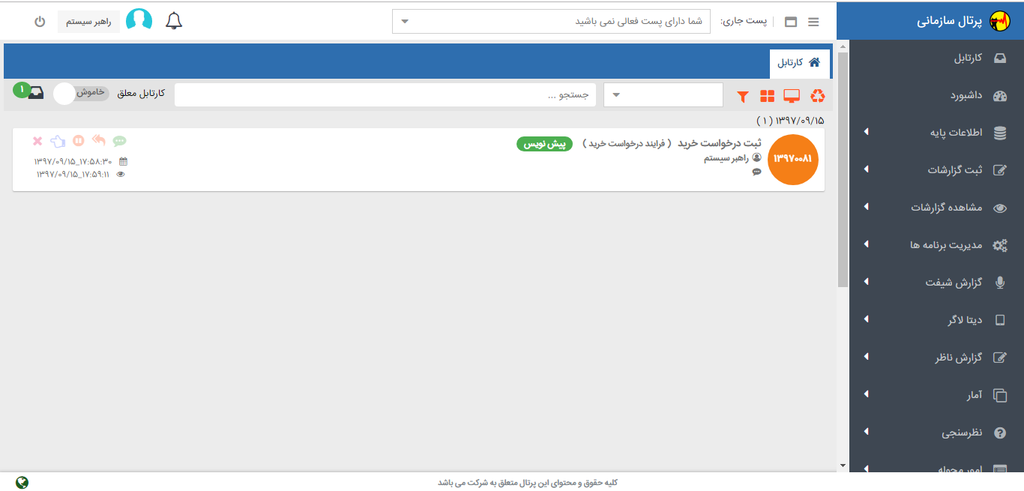
The solution was ultimately deployed at both Shahid Kaveh Qaen Combined Cycle Power Plant and Qaen Gas Power Plant.
Operational Reporting
We built structured workflows for managing shift, maintenance, supervision, equipment, and other operational reports.
Information that had previously been distributed across different processes could now be recorded, archived, and accessed through a centralized system.
This also gave management faster access to structured operational information instead of depending on data collected manually from multiple sources.
Workflow & Internal Process Automation
Paper-based and manually coordinated processes were converted into digital workflows.
This included internal requests and approval processes such as leave requests, procurement-related workflows, organizational tasks, meetings, and other administrative processes.
The goal wasn’t simply to digitize forms.
It was to move the entire process — request, review, approval, tracking, and history — into the system.
Centralized Document & Archive Management
Document handling was another fragmented area.
Before the platform, documents could depend on physical archives, separate document software, or files shared manually across the internal network.
We built a centralized document and archive system where authorized users could access records through the platform.
Instead of asking another employee to locate a file and share it over the network, a user could request access and view the scanned document directly inside the system.
Historical records could also remain available as structured digital archives rather than being scattered across different storage locations.
Equipment & Operational Data Management
The platform centralized information related to equipment status, operational readings, meters, operating hours, and equipment history.
This included records related to:
- Water
- Energy
- Fuel
- Operating hours
- Equipment performance
- Other operational measurements
The platform also supported more specialized equipment records, including hot-part lifecycle information.
Integration With Existing Systems
Not every existing application needed to be replaced.
Where specialist systems still served a useful purpose, the new platform integrated with them instead.
This included existing administrative correspondence and maintenance systems.
The goal was not to replace software simply for the sake of replacement.
The goal was to create one practical operational environment while keeping specialist systems where they still made sense.
A Key Engineering Challenge
Replacing Dedicated Data Loggers With an Offline Android Application
One of the most distinctive parts of the project was field data collection.
Operators needed to move through the plant and collect readings from approximately 1,000 equipment and measurement points.
Previously, the process depended on dedicated data-logging devices.
Operators collected the readings using specialized hardware and later connected the device to a computer using a cable to transfer its data.
We replaced those dedicated devices entirely with a custom native Android application built in Java.
But simply putting a data-entry form on a smartphone would not have solved the real operational problem.
The application had to understand how operators actually worked inside the plant.
Designed Around the Operator’s Route
The Android application allowed inspection points and equipment to be configured in the order operators were expected to visit them.
Operators could therefore follow a predefined inspection sequence instead of working with an unstructured list of measurements.
The application provided a graphical interface for recording readings and could validate entered values against configured acceptable ranges.
If a reading fell outside the expected range, the application could alert the operator immediately.
The application could also record location information using GPS, providing additional visibility into inspection routes and whether expected locations had been visited.
This transformed the solution from a simple digital form into a practical field operations tool.
Field data collection became part of the wider operations platform rather than an isolated process.
Offline by Design
Built for an Environment Without Public Internet Access
Public Internet connectivity was not available for normal system operations because of the plants’ security requirements.
That constraint influenced the architecture from the beginning.
Operators could collect equipment readings completely offline while moving through the plant.
When they returned to an authorized network area, the Android application could synchronize the collected data with the internal server through the local Wi-Fi network or via cable.
Collect Offline → Return to Internal Network → Synchronize → Centralize → Report
Once synchronized, field information became available within the central platform for reporting, historical records, and management use.
Normal operation of the platform therefore had no dependency on public Internet access.
Software updates could be handled separately when required.
More Than a Data Logger Replacement
Moving from dedicated data-logging hardware to Android devices created several practical advantages.
The plants no longer needed specialized hardware for this field data collection workflow.
Android devices provided a richer graphical interface and made it possible to support:
- Configurable inspection routes
- Configurable equipment sequences
- Reading validation
- Acceptable-range monitoring
- Operator alerts
- Offline data collection
- GPS-assisted route visibility
- Wi-Fi synchronization
- Cable synchronization
- Centralized reporting
Because the application was connected to the wider operations platform, the collected information could immediately become part of the same environment used by managers and other operational systems after synchronization.
The legacy dedicated data-logging devices were fully replaced by the Android solution.
Beyond Field Data Collection
The Android application was only one part of a much larger platform.
Implemented capabilities included:
- Authentication and role-based access based on the organizational structure
- Employee shift management and shift changes
- Shift reporting
- Maintenance reporting
- Project supervision and operational reporting
- Equipment performance and status records
- Hot-part lifecycle records
- Tasks and work management
- Organizational calendars
- Meeting management
- Procurement and purchase-request workflows
- Water, energy, fuel, and operating-hour meter records
- Document management
- Digital archives
- Management and operational reporting
- User dashboards and internal announcements
- Multi-channel notifications
- Organizational suggestion management
- Surveys
- Integration with administrative correspondence systems
- Integration with maintenance software
- Offline Android field data collection
These were not developed as unrelated applications.
They operated as parts of the same platform, sharing users, permissions, workflows, records, and operational information.
Business Impact
From Fragmented Processes to a Central Operational Environment
The biggest result of the project was not one individual feature.
It was consolidation.
Processes that previously depended on standalone software, paper, manual archives, network file sharing, and disconnected workflows could now operate within a more centralized digital environment.
And because the platform was successfully deployed at two power plants, the solution was not limited to a single isolated installation.
Dealing With Disconnected Tools or Manual Workflows?
We help companies turn fragmented workflows, legacy systems and operational processes into practical custom software built around how their teams actually work.
Discuss Your Project →Fewer Disconnected Tools
Multiple processes that previously depended on separate software or manual workflows were brought into the central platform.
Where an existing specialist system still made operational sense, it could remain in place and integrate with the platform.
Faster Access to Management Information
Operational information was structured and centralized.
Managers could access reports and historical information without depending as heavily on manual collection from separate systems and sources.
Less Paper-Based Work
Internal requests and approval processes could move through digital workflows.
Processes such as leave requests no longer needed to depend entirely on paper forms and manual follow-up.
Centralized Digital Archives
Documents, operational reports, equipment records, and historical information could be maintained in digital archives instead of relying primarily on physical filing systems or scattered files.
Easier Access to Documents
Authorized users could find and view scanned documents directly through the system.
This reduced reliance on manually sharing documents between employees over the internal network.
Structured Operational History
The system could maintain historical records of operational information, documents, equipment data, reports, and system changes.
This created a more complete digital history of activities instead of leaving important information distributed across isolated files and systems.
Dedicated Data-Logging Hardware Eliminated
The custom Android application completely replaced the legacy dedicated data-logging devices used for field readings.
This eliminated the dependency on specialized hardware while giving operators a more flexible and configurable field data collection tool.
Technology & Architecture
The system was designed around the constraints of an industrial, security-sensitive, fully on-premise environment.
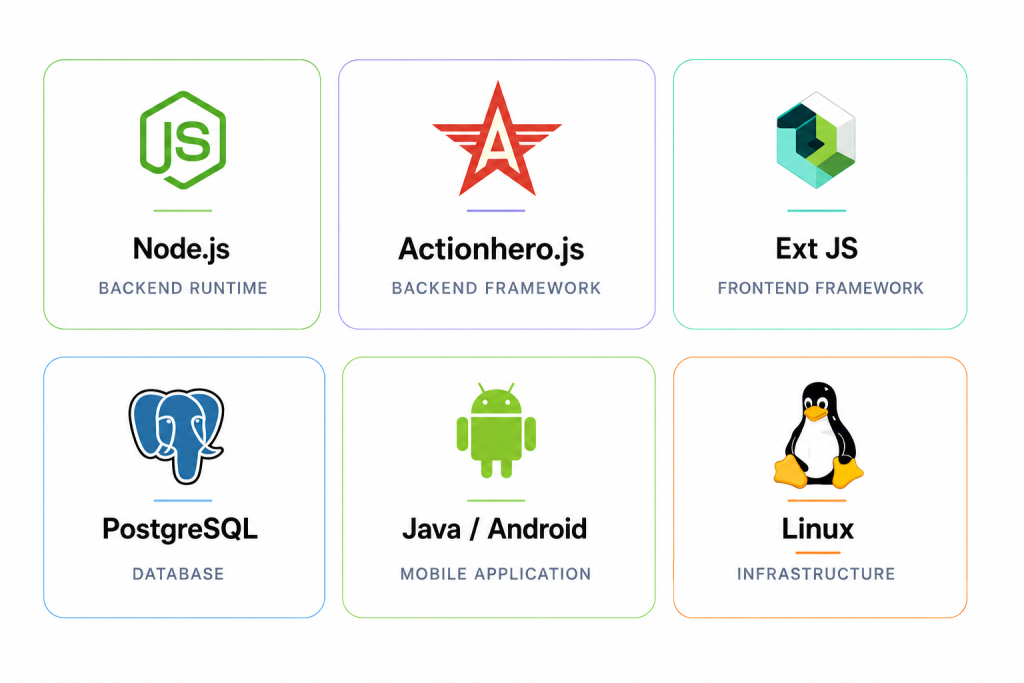
Backend
Node.js + Actionhero.js
Frontend
Ext JS
Database
PostgreSQL
Mobile Application
Native Android / Java
Deployment
Fully On-Premise
Connectivity
Internal network with no dependency on public Internet for normal operations
Infrastructure
Separate server infrastructure was used for the backend/database and application delivery.
The architecture allowed operational information to remain inside the plants’ infrastructure while still supporting synchronization between mobile field devices and the central platform.
Deployment Across Two Power Plants
The platform was deployed at:
Shahid Kaveh Qaen Combined Cycle Power Plant
Qaen Gas Power Plant
Deploying the platform across two operational environments demonstrated that the solution could extend beyond a single installation while preserving the same core approach to workflows, operational information, on-premise infrastructure, and field data collection.
Delivery
From Development to Production and Support
Development took place between 2017 and 2019.
The delivery team changed during different stages of the project depending on development requirements and included project management, backend development, client-side development, and native Android development.
After development was completed, the system was fully delivered and moved into the support phase.
This was not a prototype or a proof of concept.
It became an operational platform deployed inside real power plant environments.
Client Proof
Formally Accepted by the Power Plant
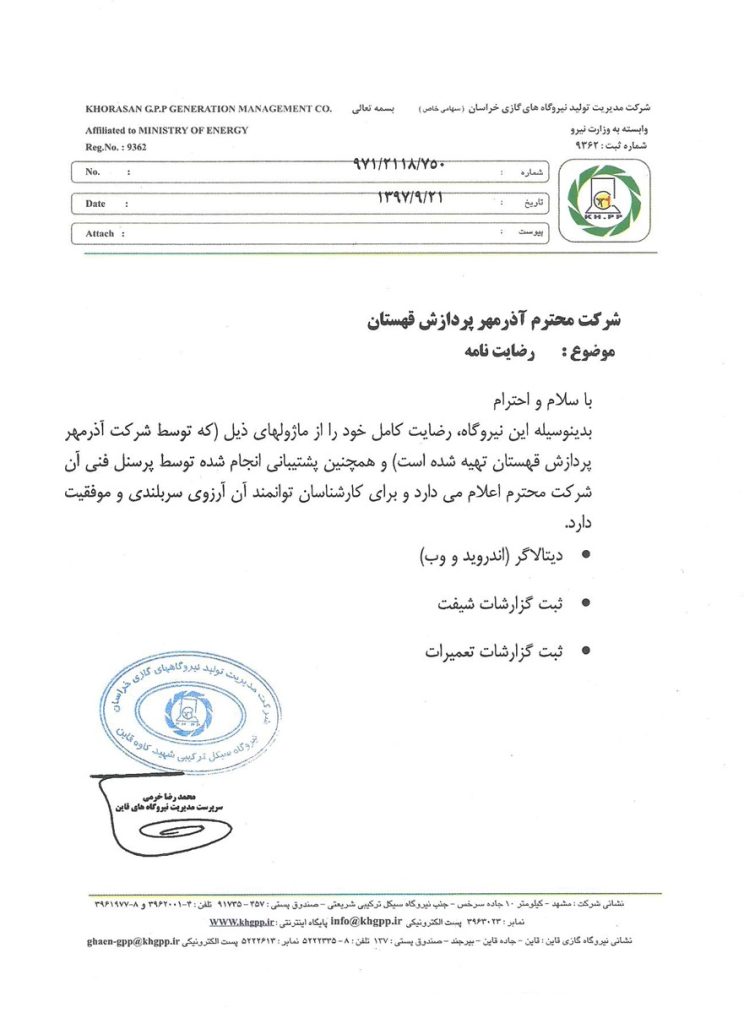
Following delivery, the project received a formal certificate of satisfactory completion from Shahid Kaveh Qaen Combined Cycle Power Plant.
What This Project Demonstrates
Custom industrial software is not always about replacing every existing system.
Often, the harder problem is deciding which workflows should be automated, which existing systems should remain, how those systems should communicate, how field staff should interact with the platform, and how everything can operate under real infrastructure and security constraints.
For this project, that meant bringing together:
- Business process automation
- Legacy system integration
- Operational reporting
- Document management
- Digital archives
- Equipment data management
- Offline field data collection
- Native Android development
- On-premise deployment
All within one practical operational platform deployed across two power plants.
You may not need to replace everything at once.
We help companies turn fragmented workflows, legacy systems, manual processes, and operational data into practical custom software.
And you don’t have to begin with a large transformation project.
Start with one workflow, integration, feature, or small project.
Evaluate our delivery, communication, and problem-solving first — then expand the engagement when it makes sense.
Start Small. See How We Work.
Start with one clearly defined feature, workflow, integration, or technical task. Evaluate our delivery, communication, and problem-solving before expanding the engagement.
Try Before You Trust →
